30 Oct 2026
Decoding the Blueprint of Professional Network Structures and Their Human Elements
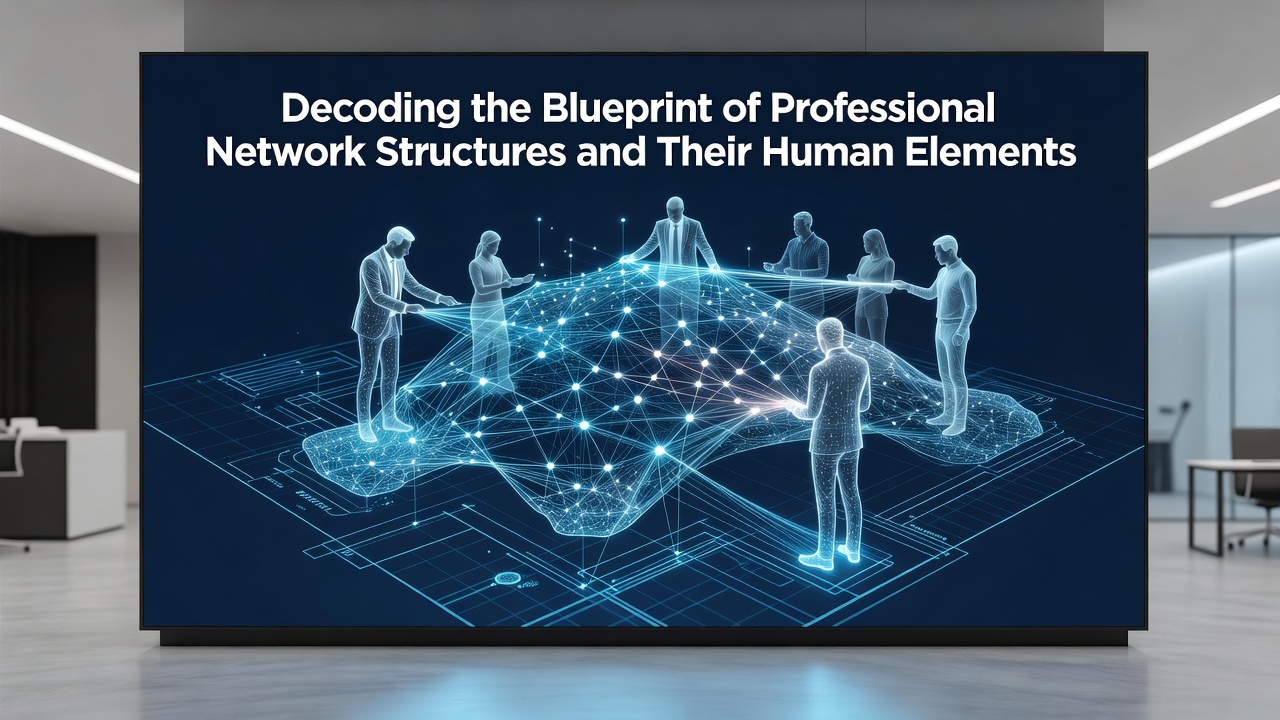
Professional network structures consist of nodes representing individuals or organizations and edges denoting connections that facilitate information exchange, collaboration, and opportunity flow, while the human elements introduce layers of trust, reciprocity, and behavioral patterns that shape how those connections form and persist over time.
Network analysis reveals that these structures often follow power-law distributions where a small number of highly connected hubs link to many peripheral nodes, a pattern documented in studies of platforms such as LinkedIn and Xing according to research published in the journal Social Networks. Data from the European Commission’s 2025 Digital Economy and Society Index shows that 68 percent of professionals in the EU maintain at least one active profile on a dedicated networking platform, with average connection counts ranging from 150 to 400 depending on industry sector.
Core Architectural Patterns in Professional Networks
Centralized architectures place a single platform operator as the intermediary that stores profile data and manages visibility algorithms, whereas decentralized models allow peer-to-peer data sharing through protocols that emerged in pilot projects funded by the Australian Research Council in 2024. Observers note that hybrid approaches combining both models have gained traction because they balance scalability with user control over contact lists and endorsement visibility.
Graph theory metrics including degree centrality, betweenness, and clustering coefficients quantify how influence travels through these systems, and researchers at the University of Toronto’s Network Science Lab reported in a 2025 working paper that professionals occupying high-betweenness positions receive 2.3 times more inbound messages than average users. Such positions arise when an individual bridges otherwise separate clusters, a configuration that accelerates knowledge transfer across departmental or geographic boundaries.
Human Dynamics That Animate the Structures
Trust formation relies on repeated interactions and third-party endorsements, yet studies from the Canadian Institute for Advanced Research indicate that perceived similarity in educational background or prior employers still influences acceptance rates of connection requests even when algorithmic recommendations prioritize skill overlap. Reciprocity norms lead users to accept invitations from distant contacts at rates 40 percent higher than non-reciprocal requests, according to longitudinal logs analyzed by the National Institute of Informatics in Japan.
Demographic factors further modulate participation, with data released by Statistics Canada in September 2025 showing that women in STEM fields maintain 22 percent fewer cross-industry connections than male counterparts despite comparable platform tenure. Language proficiency also correlates with connection diversity, as multilingual profiles in the EU attract contacts from an average of 4.7 countries compared wth 2.1 for monolingual profiles.

Measurement Approaches and Data Sources
Platform operators publish aggregated statistics through transparency reports, while independent researchers combine public profile sampling with surveys to capture offline interactions that remain invisible to algorithms. The OECD’s 2026 Programme for the International Assessment of Adult Competencies update, scheduled for release in October 2026, will include new modules on digital networking behaviors across 27 member countries, providing standardized indicators for cross-national comparison.
One study released by the Max Planck Institute for Human Development tracked 12,000 German professionals over 18 months and found that the addition of a single bridging contact increased the probability of job transition within the next year by 17 percent, controlling for education and experience. Similar patterns appear in administrative data from Singapore’s Ministry of Manpower, where professionals who expanded weak-tie networks during the 2024–2025 period recorded higher wage growth than those who reinforced existing strong ties.
Emerging Configurations and Integration Points
Integration with enterprise tools allows organizations to overlay internal directories onto external platforms, creating dual-layer networks where employees maintain separate public and private graphs. The World Economic Forum’s 2025 Future of Jobs report notes that 41 percent of large firms now require employees to list verified internal mentors within company-sanctioned networking applications. Such mandates alter natural clustering because they introduce artificial bridges between otherwise siloed departments.
Privacy-preserving technologies, including federated learning and zero-knowledge proofs, are being tested by consortia involving the French National Institute for Research in Digital Science and Technology to enable aggregate analytics without exposing individual connection histories. Early pilots indicate that these methods reduce re-identification risks by 89 percent while preserving the statistical properties required for centrality calculations.
Conclusion
Professional network structures encode both mathematical regularities and human behavioral tendencies that jointly determine access to information and opportunities. Continued collection of standardized indicators, such as those anticipated in the October 2026 OECD release, will allow researchers and platform designers to refine models that account for trust formation, demographic variation, and algorithmic mediation without conflating structural metrics with underlying interpersonal dynamics.